Ep. 14 min read
What your pharmacist can help with: Praise Fadzai
Pharmacist Praise Fadzai explains what you can ask about your skin, including everyday product questions and when to see a GP.
Read the episode →
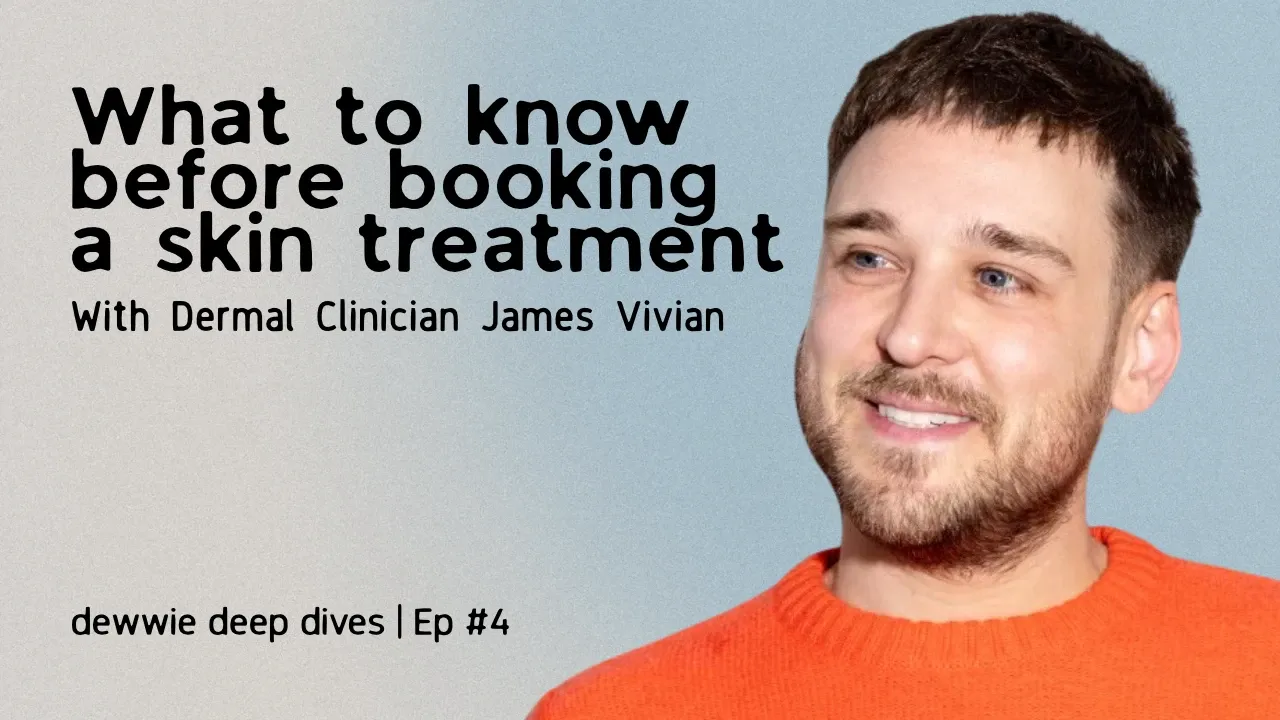
Melbourne dermal clinician James Vivian on the warning signs to watch for when choosing a skin clinic, what a good consultation covers, and when a treatment package makes sense.
Watch on YouTubeChoosing a skin clinic to start your skin journey can feel harder than it should be.
Treatments are an investment, job titles in clinic can be confusing with terminology from across the world reaching us on social media, and clinic’s social feels often promise results regardless of your skin goals.
This guide covers the red flags to watch for and what a good consultation looks like, to help you find the right clinic for you and your skin.
In this article we’re recapping our dewwie Deep Dives chat with James Vivian, a Melbourne dermal clinician with more than 20 years in the industry.
James has worked on both sides of the industry, first as a beauty therapist and then as a dermal clinician.
Pause before you book or agree to a treatment if you notice any of these:
James is a dermal clinician and the founder of James Vivian, a skin clinic in Toorak, Melbourne.
He began as a beauty therapist and soon realised how much more there was to know about skin.
That sent him back to study a health science degree in dermal therapies. He has combined the two worlds ever since, and credits beauty therapy with laying the groundwork for the dermal industry he embraces, including his ability to relate to and listen to clients.
His business started about 16 years ago as the Travelling Peelsman, a one man show where James would bring his treatment bed and a bag of chemical peels to client visits at their homes, dropping their personalised products back afterwards.
It grew slowly into a clinic with a team of therapists.
Most red flags show up in how a clinic talks about its treatments, often on social media, before you’ve even set foot inside.
James has written more on this for White Rabbit Social in What’s broken in the aesthetic industry (and how to fix it).
No. What matters to one person is irrelevant to the next, and a clinic can be a poor fit for you and your skin goals without doing anything wrong. Timing matters too.
“The right clinic for you might actually be the wrong one right now but the right one later on,” James said.
A poor fit isn’t a red flag.
The signs below are, because they show how a clinic treats people and their skin holistically.
No clinic can guarantee a result. Skin responds differently from person to person, and even the best practitioner on the best device can’t promise an outcome.
“No clinic can have a solution to everything,” James shared.
Be just as cautious about results promised after one session. Results usually build over several treatments, as a clinician learns how your skin responds.
Some clinics also have more experience with certain skin types or concerns, and can lean into or away from their strengths depending on your needs.
It’s ok to ask questions like “have you treated someone with my skin type / colour / age before?”.
Listen for the difference between “we will clear your skin” and “clearer skin”.
The first is a promise nobody can keep. The second allows for the fact that what is achievable for one person may not be for the next.
A clinic’s wording sets your expectations before you walk through the door. One that admits uncertainty is being upfront about what a treatment can reasonably do.
If something doesn’t feel right, stop. You should understand the proposed treatment, its risks, and its cost before you agree to anything, and you should have room to say no.
“Don’t consent if you’re feeling rushed into something,” James said.
A consultation isn’t a commitment. NSW Government consumer guidance on beauty and cosmetic services also warns about high-pressure sales tactics.
A clinician who doesn’t ask what you’ve already tried is working blind. Your history stops them repeating what has failed and shows what your skin tolerates.
At James’s clinic, the first question on the consultation form is whether you’ve spoken to a professional before.
If you have, he wants all of it: where you’ve been, what you’ve used, and what did or didn’t work.
A good consultation finds out why you’re there before anyone suggests a treatment. That means your skin history, what you’re hoping for, and how you feel about being there.
Say so. A first visit is a big step, and a good clinician will slow down, explain more, and check how you’re feeling about it. Being nervous is normal.
“Don’t worry. We do this all the time,” James tells first-time clients.
Yes. When there is work to do, you should hear it plainly, along with what to expect and how long it is likely to take.
You should also hear it when something else needs addressing first, or when a treatment is unlikely to give you what you’re hoping for. Those conversations are harder, and they are a sign the clinician is being straight with you.
Sometimes. Packages suit maintenance far better than they suit someone still working out what their skin needs.
A deal like six treatments for the price of four sounds sensible when single appointments are expensive.
The catch is that it locks you into one treatment for months. What looked right on day one may not be what your skin needs by session three, and how you feel about your skin can change too.
James often meets people who finished a long package elsewhere even though it stopped feeling right early on.
Their skin wasn’t harmed, and the treatments did something. They just never addressed what the person came in for.
When you’re already happy with your skin and know which treatment keeps it that way. A monthly or quarterly session on a package can be good for your skin and your budget.
Packages also make more sense at a clinic that specialises in one treatment, because you know exactly what you’re getting.
Either way, look for a plan that is reviewed as you go and gives you a way out.
All three work with skin. What differs is the training behind the title.
| Title | Typical training in Australia |
|---|---|
| Dermal clinician | A bachelor’s degree in dermal science, dermal therapies, or similar |
| Dermal therapist | Advanced study in dermal therapy, such as an advanced diploma or graduate diploma |
| Beauty therapist | Vocational training, such as a Certificate IV or Diploma of Beauty Therapy |
The Australian Society of Dermal Clinicians (ASDC) sets out who should use each title. In practice nobody polices it.
The ASDC is run by volunteers, and neither title is registered the way medical professions are, so ask a practitioner what they studied. The ASDC also lists its recognised education pathways.
Aesthetician, or esthetician, is the American term for a role broadly comparable to a beauty therapist.
Not on its own. Qualifications matter, and so does time spent with real skin.
“You can have an extraordinarily knowledgeable and talented beauty therapist, and you can have a very naive and inexperienced dermal clinician,” James explained.
A beauty therapy diploma used to be a prerequisite for the dermal degree James studied, so graduates arrived with years in treatment rooms behind them.
Students can now go straight from school into a dermal degree and graduate with the knowledge but little hands-on time.
Ask who will be treating you, how long they have been doing it, and why they are recommending this treatment in particular. James’s guide to eight things to look for in a good skincare clinic covers more.
It depends on the clinic, its practitioners, and its equipment. The most common offerings are chemical peels and laser or light-based treatments, generally aimed at the appearance of redness and pigmentation.
Lasers range from gentle options like Laser Genesis to far more intensive CO2 resurfacing.
Skin needling is increasingly common, sometimes paired with mesotherapy, where ingredients are introduced during the treatment. Some clinics also offer energy-based skin tightening with devices such as Thermage and Ultraformer.
Many clinics offer cosmetic injectables alongside skin treatments. Others, including James’s, choose not to so they can focus on skin. Either way, a good clinic knows what it can and can’t achieve and tells you.
Not sure you need a clinic at all? James has shared five signs it may be time to see a skin professional.
They can be. If skin is congested, other treatments can only do so much while the congestion is still sitting there. Sometimes careful extractions do more than a device would.
James calls extractions “a dying art form” and still builds them into his treatments, alongside the cleanse and massage of a traditional facial. His name for the mix is “the pampering and the pain”.
A good clinician will sometimes tell you not to have a treatment.
“Sometimes as a therapist the best treatment can be no treatment,” James shared.
James’s example is a new mother who comes in saying she no longer looks like herself. She is exhausted and has been through enormous change. What has shifted is how she feels, and a procedure won’t fix that.
That is different from being dismissed. Your concern should still be heard, and if there is something worth treating, you should be told.
People often arrive at a clinic already feeling vulnerable about how they look. How a clinician talks about your skin matters as much as what they do to it.
“The words that we say can hit just as hard as any treatment, or can sometimes hit harder,” James said.
You should leave feeling good as well as looking good. At James’s clinic, signs above the treatment beds read “Your inner critic isn’t booked in today”.
Be wary of scripts too. “Tell me two things you dislike about your skin and one thing you like” sounds balanced, but you might have four concerns, or nothing you feel like celebrating that day.
It’s a fair term when the concern is yours. It describes something you’ve raised, as opposed to a flaw someone has pointed out to you.
James is comfortable with the word because he sees his work as “solutions to problems”.
If clients had no concerns, he says, there would be no need to go to work, and he doesn’t think that would be a bad thing.
They are useful, with context. Look at every image as a sceptic would, including the ones taken in a clinic.
Memory, mostly. During a bad skin month it can feel like your skin has never been worse, and it is hard to recall what it looked like eight months ago. A baseline photo settles it.
Images work the other way too. They show when a treatment isn’t delivering, or when a clinic has caused a problem it needs to fix.
Imaging can also pick up pigmentation that isn’t obvious to the naked eye, such as early signs of melasma, so a clinician can be mindful of it.
James’s clinic and many others use VISIA imaging for this.
A scan doesn’t capture everything. Congestion under the skin, for example, doesn’t show up, so a clinician’s own observation still counts.
Photos are easy to skew without anyone meaning to. Different lighting on two different days can make an after photo look better or worse than it should. So can the day itself, if the after shot happens to catch a good skin day.
Even the screen matters. At a training seminar, James watched the same before-and-after shown on two screens. On one it looked extraordinary. On the other it looked good. Only the resolution had changed.
Not directly. A scan can show redness and vascularity, and barrier-impaired skin is often warmer and more flushed. Less redness over time can suggest the barrier is recovering.
Be cautious. Some devices produce a “true age” or a percentile ranking, and those numbers can work as a sales tool that pushes you towards a treatment or a new routine.
A score is only as useful as the person interpreting it, and it should be weighed against what you came in for.
Progress photos can help you judge whether a routine is working. Keep the lighting, angle, and time of day consistent, and remember that one good or bad skin day can distort the comparison.
Cosmetic skin scans and progress photos are not a skin cancer check, and we encourage people to show their doctor any spots or moles they’re not sure of as often as possible.
Cancer Council Australia recommends having new or changing spots assessed by a doctor.
No. Choose products for your skin and your preferences. There are some physiological differences between male and female skin, but a “for men” label isn’t a requirement.
“Skin care is skin care regardless of what gender you are,” James said.
Those products still have a place. Skin clinics and the skin industry are dominated by women, and men don’t often see themselves reflected there.
If a product marketed to men is what gets someone started, that’s a win.
White Rabbit Social’s men’s skincare and hygiene guide is a practical place to start.
James says more men are walking into his clinic than there used to be.
Guaranteed results, promises of a result after one treatment, and absolute claims like “we will clear your skin” are the main ones, according to dermal clinician James Vivian. Feeling rushed to consent and being sold a package with no review point are also worth questioning.
They can be for maintenance, when you already know which treatment suits your skin. They are riskier when you’re starting out, because a package locks you into one treatment even if your skin or your goals change.
A clinician should ask what you’ve already tried and why you’ve come in, then explain what to expect and how long it may take. You should be able to leave without committing to a treatment.
A dermal clinician has typically completed a bachelor’s degree in dermal science or dermal therapies. A beauty therapist has typically completed vocational training such as a Diploma of Beauty Therapy. Experience matters alongside either qualification.
Active breakouts are usually addressed first, because new breakouts can keep leaving new marks. A clinician can advise on what suits your skin.
Only with context. Lighting, timing, and even screen resolution can change how results look, so compare photos taken under the same conditions.
No. Products should be chosen for your skin and preferences, not the gender on the label.
Pharmacist Praise Fadzai explains what you can ask about your skin, including everyday product questions and when to see a GP.
Dr Yalda Jamali explains who to see about your skin and how to recognise when a concern needs medical care.
Former Priceline beauty advisor Lily Roulston on how social media changed skincare shopping and what to ask before buying a product.